
SEO Skills for AI Agents in 2026
A practical guide to SEO-related skills in the Awesome Skills index, covering SEO audits, keyword research, metadata, schema markup, Core Web Vitals, programmatic SEO, and AI search visibility.
Awesome Skills Team
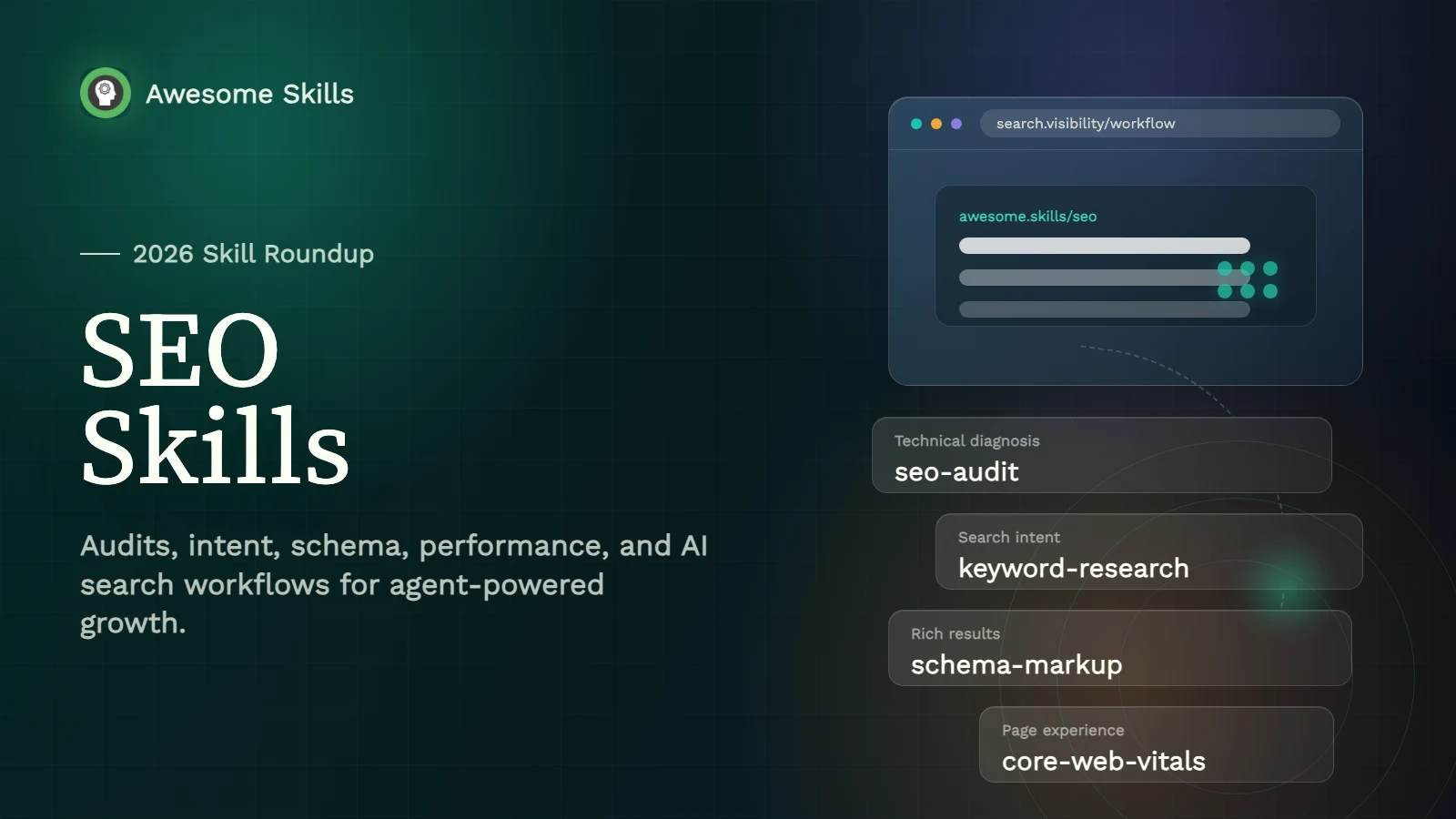
SEO Skills for AI Agents in 2026
SEO skills are easy to misunderstand. The weak version is a prompt that says "add keywords" or "write a meta description." The useful version is a repeatable workflow that helps an agent inspect crawlability, understand search intent, fix metadata, add structured data, check performance, and decide whether a page deserves to exist.
That matters more in 2026 because SEO work now spans traditional search, rich results, Core Web Vitals, site architecture, and AI answer surfaces. Google's SEO Starter Guide still frames the basics clearly: help search engines understand your content and help users decide whether your page is worth visiting. Agent skills are valuable when they turn that broad advice into a practical checklist.
For this guide, we reviewed SEO-related entries in the current Awesome Skills index and cross-checked the categories against official Google Search Central documentation. This is not a strict ranking. It is a map of which SEO skills fit which job, and where each one can go wrong if you let the agent run without judgment.
How We Picked the SEO Shortlist
Searching for "SEO" is cleaner than searching for "design" or "browser," but it still catches noisy results. Some entries are about database schemas, hybrid search, repository metadata, or general content marketing rather than website search visibility. We filtered for skills that directly help with one of these workflows:
- technical SEO audits, crawlability, indexing, and diagnostics
- keyword research, search intent, and content planning
- on-page metadata, canonical URLs, Open Graph, and robots directives
- schema markup and structured data
- site architecture, internal linking, sitemaps, and programmatic pages
- Core Web Vitals and page performance
- AI SEO, AEO, GEO, and LLM citation readiness
The best SEO skills are not magic ranking tools. They create a sequence: observe the current page, diagnose the gap, recommend a scoped fix, and verify the result against real search and user constraints.
The SEO Skills Worth Trying First
| Skill area | Representative skill | Best fit | Watch out for |
|---|---|---|---|
| Broad SEO workflow | seo | End-to-end audit, technical SEO, on-page optimization, structured data, Core Web Vitals, and content strategy | A broad skill still needs a concrete page, site, or metric |
| SEO diagnosis | seo-audit | Traffic drops, crawl issues, indexing problems, page speed, and on-page gaps | An audit is not the same as implementation |
| Keyword planning | keyword-research | Search intent, topic clusters, keyword opportunities, and content prioritization | Volume without business fit creates busywork |
| Content strategy | content-strategy | Editorial calendars, content pillars, and topic decisions | Strategy can become generic if product context is missing |
| Metadata cleanup | fixing-metadata | Titles, descriptions, canonicals, social cards, favicons, robots directives, and JSON-LD checks | Templated metadata can flatten important page differences |
| Structured data | schema-markup | JSON-LD, Schema.org, rich result eligibility, FAQ/Product/Review/Breadcrumb markup | Valid markup does not guarantee a rich result |
| Page performance | core-web-vitals | LCP, INP, CLS, and page experience improvements | Metrics should support user experience, not replace it |
| Programmatic SEO | programmatic-seo | Template-driven pages at scale, directories, comparisons, and location pages | Thin scaled pages can become search-first content |
| AI search visibility | ai-seo | AI Overviews, LLM citations, AEO, GEO, and answer engine optimization | AI visibility still depends on clear, useful, trustworthy content |
If you only try one skill, start with an audit-oriented one. If you already know the technical state of the site, move into keyword research, metadata, schema, and performance. Programmatic SEO can be useful, but it should come late, not first.
1. Start With SEO Audit Skills, Not Random Fixes
The most useful SEO work usually begins with diagnosis. A page may be underperforming because it is not indexed, blocked by robots directives, missing canonical clarity, slow on mobile, thin on content, poorly linked, or targeting the wrong intent. Those are different problems. They should not all receive the same "optimize the title tag" treatment.
That is why seo-audit and broader seo skills are the safest starting point. They push the agent to inspect the site before prescribing work. A good audit skill should ask what page matters, whether the issue is technical or content-led, what data exists, and what would count as a useful fix.
Use this category when someone asks, "Why are we not ranking?", "Why did traffic drop?", "Is this page indexable?", or "What should we fix first?" The output should be a prioritized diagnosis, not a generic checklist.
2. Keyword Research Skills Need Intent, Not Just Volume
Keyword research is useful when it helps a team decide what to create, update, merge, or ignore. It is less useful when it produces a spreadsheet of terms with no connection to the product.
keyword-research is built for that first layer: search volume, difficulty, intent classification, and topic clusters. Pair it with content-strategy when the question is "which pages should this site publish next?"
The important word is intent. A phrase can look attractive and still be wrong for the business. A user searching for a definition, a comparison, a template, and a buying page may use overlapping language, but they need different pages. A good keyword skill should separate those cases before it suggests titles or article briefs.
3. Metadata and Schema Skills Are High-Leverage but Easy to Overdo
Metadata fixes are often fast SEO wins because they are concrete. Titles, meta descriptions, canonical URLs, Open Graph tags, Twitter cards, favicons, JSON-LD, and robots directives can be inspected directly. fixing-metadata fits this layer because it focuses on signals search engines and social platforms read before anyone rewrites the whole site.
Schema markup is nearby but not identical. schema-markup and schema-markup-generator are useful when the page has a clear entity or content type: article, product, FAQ, local business, review, breadcrumb, event, or how-to. Google's structured data documentation explains that structured data gives search engines explicit clues about the meaning of a page.
Here is the catch. More markup is not automatically better. A schema skill should validate the JSON-LD, match the right feature type, and avoid inventing properties just to make the page look richer.
4. Site Architecture Skills Keep Pages Discoverable
SEO is not only page-by-page work. Search engines and users both need to understand how a site is organized. That is why site-architecture belongs in the SEO stack.
This area is useful when a site has disconnected pages, unclear navigation, duplicated URL patterns, poor internal linking, or no obvious path from the homepage to important content. It can help map hierarchy, plan breadcrumbs, and decide which topics deserve directories.
Google's sitemaps documentation makes the point cleanly: sitemaps help search engines discover important URLs, especially on large, new, or media-heavy sites, but internal links still matter.
This is also where programmatic-seo becomes tempting. It can help create template-driven comparison, location, directory, or integration pages. Use it only when the site has real data, a clear user need, and enough unique value per page.
5. Core Web Vitals Skills Connect Performance to Search Experience
Performance belongs in this guide because SEO is not only text. A page that loads slowly, shifts around, or responds late can lose users before the content has a chance to matter.
core-web-vitals and web-perf are strong fits for agent work because they turn vague complaints into measurable investigation. They can look at LCP, INP, CLS, render-blocking resources, large images, layout shifts, request chains, caching, and JavaScript cost.
The best use case is not "make the score green" in isolation. It is closer to: "This product page is important, mobile traffic is high, and users are bouncing. Find the biggest performance constraint and suggest the smallest fix that improves the experience." A performance skill should help find the bottleneck, not just recite metric definitions.
6. AI SEO and AEO Skills Are Emerging, but Fundamentals Still Matter
AI search visibility is now a real category in the index. ai-seo, seo-geo, and seo-aeo-best-practices focus on AI Overviews, answer engines, LLM citations, GEO, AEO, and related workflows.
These skills are useful when a team wants content that can be understood, cited, and summarized by AI systems. Practical work might include clearer entity descriptions, concise answer blocks, source-backed claims, author context, structured data, and pages that answer follow-up questions.
But this category needs restraint. Google's people-first content guidance is still a good guardrail: content should primarily help people, not exist only to manipulate search rankings. Google's guidance on AI-generated content also warns against large-scale automated content that adds little value. AI SEO skills should sit on top of the fundamentals, not replace them.
A Practical Stack for SEO Work
You do not need every SEO skill at once. A compact stack is usually better:
- seo-audit or seo for diagnosis and prioritization.
- keyword-research plus content-strategy for search intent and topic planning.
- fixing-metadata for titles, descriptions, canonicals, social cards, robots directives, and page metadata.
- schema-markup or schema-markup-generator for structured data that matches visible content.
- site-architecture for hierarchy, internal links, breadcrumbs, URL patterns, and sitemap planning.
- core-web-vitals or web-perf for performance work tied to important pages.
- programmatic-seo only when the site has real data and a quality control plan.
- ai-seo or seo-aeo-best-practices after the basics are already healthy.
That order is deliberate. Diagnose before writing. Understand intent before scaling content. Fix metadata and schema after the page has a reason to exist. Treat AI search as an extension of usefulness, not a shortcut.
Why Trust This Guide
This guide is based on current Awesome Skills entries that explicitly target SEO, plus official Google Search Central documentation on SEO fundamentals, structured data, sitemaps, helpful content, and AI-generated content. We filtered out false positives where "schema," "search," or "metadata" referred to database design, vector retrieval, or unrelated tooling.
The lens is practical fit: inspect first, classify the job, make a scoped recommendation, and preserve the difference between technical eligibility and content quality.
Final Takeaway
SEO-related skills are best used as a system. Start with an audit skill to understand the site, then bring in keyword research, content strategy, metadata, schema, site architecture, performance, and AI search skills as the work becomes clearer.
If you want to explore more, start with the Awesome Skills collection, search for "SEO", "keyword research", "schema markup", "Core Web Vitals", or "AI SEO", and read the actual SKILL.md before installing. The description gets a skill discovered. The instructions decide whether it can help you improve a real site.