
Research and Analysis Skills for AI Agents in 2026
A practical guide to research and analysis skills in the Awesome Skills index, covering source-backed research, literature reviews, OpenAlex and PubMed workflows, market research, financial analysis, citation management, and evidence-based reporting.
Awesome Skills Team
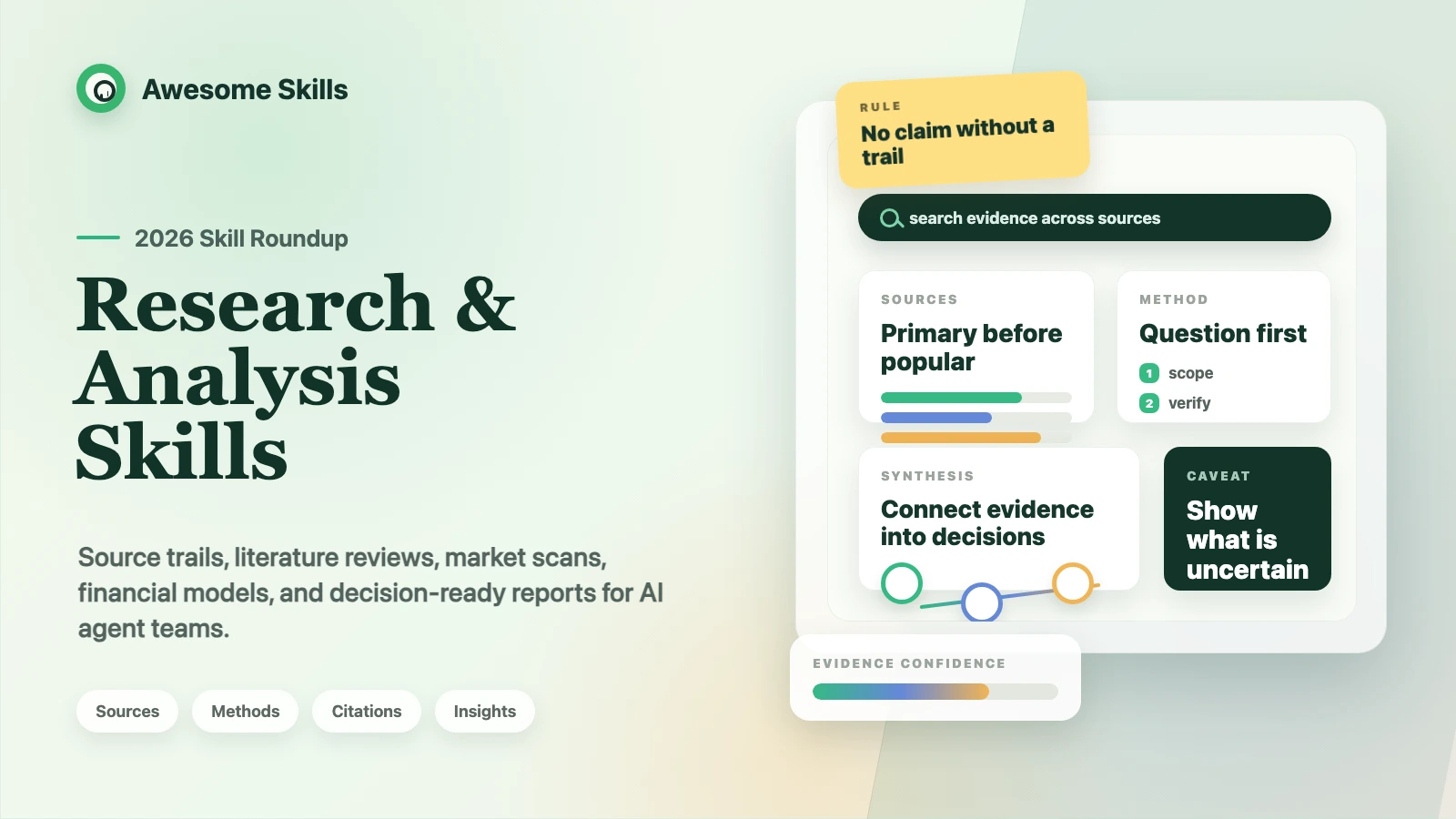
Research and Analysis Skills for AI Agents in 2026
Research and analysis skills are where AI agents can either become genuinely helpful or confidently misleading. A general agent can search the web, summarize a paper, or turn numbers into a neat paragraph. A good research skill makes the agent slower in the right places: it asks what question is being answered, what sources count, how fresh the evidence needs to be, what assumptions are being made, and how the final answer should be checked.
That matters because research work is rarely just collection. It is judgment. A useful agent has to separate facts from interpretation, primary sources from commentary, current evidence from stale claims, and signal from a pile of loosely related links.
For this guide, we reviewed research and analysis entries in the current Awesome Skills index, then checked public documentation from OpenAlex, Crossref, Pew Research Center's methods pages, and Anthropic's writing on Agent Skills. This is not a ranking. It is a map of which research skill fits which job, and where the agent needs human judgment.
How We Picked the Shortlist
Searching for "research" or "analysis" catches a wide range of skills: broad web research, content research, lead research, market research, literature reviews, scholarly databases, citation management, financial analysis, data storytelling, fact checking, and report generation. For this article, we focused on skills that help an agent with one of these workflows:
- clarifying the research question before searching
- gathering source-backed evidence
- finding academic papers and metadata
- reviewing literature without flattening disagreement
- managing citations and bibliographic context
- researching markets, competitors, leads, or industries
- analyzing financial statements and assumptions
- turning evidence into a clear report or recommendation
- marking uncertainty instead of hiding it
The strongest research skills do not just summarize. They create a trail: question, method, sources, evidence, synthesis, caveats, and next steps.
The Research and Analysis Skills Worth Trying First
| Skill area | Representative skill | Best fit | Watch out for |
|---|---|---|---|
| General research | research | Broad web research, issue exploration, and source gathering | Search results are not evidence by themselves |
| Research-backed writing | content-research-writer | Source-backed articles, briefs, and structured drafts | Citations should support claims, not decorate them |
| Market research | market-research-reports | Market sizing, competitor scans, customer trends, and industry reports | Market claims go stale quickly |
| Lead research | lead-research-assistant | Target account research, prospect context, and outreach preparation | Prospecting quality matters more than list size |
| Literature review | literature-review | Academic topics, paper discovery, synthesis, and gap finding | A summary is not the same as a review |
| Scholarly metadata | openalex-database | Works, authors, institutions, topics, citations, and research trend analysis | Metadata can be incomplete or ambiguous |
| Biomedical search | pubmed-database | Biomedical literature, PubMed queries, and paper metadata | Medical conclusions need domain review |
| Citation workflow | citation-management | Bibliographies, citation styles, source tracking, and reference cleanup | Bad source selection cannot be fixed by formatting |
| Financial analysis | analyzing-financial-statements | Income statements, balance sheets, cash flow, and ratio analysis | Numbers need context and period definitions |
| Financial modeling | creating-financial-models | Forecasts, assumptions, scenarios, and sensitivity analysis | A model is only as useful as its assumptions |
| Data storytelling | data-storytelling | Turning analysis into reports, narratives, and stakeholder decisions | A polished narrative can overstate weak evidence |
If you only start with one category, start with general research plus citation discipline. Most bad AI research does not fail because the prose is weak. It fails because the source trail is thin.
1. Research Skills Should Start With the Question
The most useful research step often happens before the first search. What are we trying to decide? Is this exploratory research, a literature scan, market sizing, competitive analysis, due diligence, or a fact check? How current do the sources need to be? What would count as a trustworthy answer?
research and content-research-writer fit this first layer. They help when the task needs source gathering, claim support, outline building, and synthesis. The danger is letting the agent collect too much without deciding what the research is for.
A better prompt is not "research this topic." It is closer to: "define the research question, list what sources would count, search across at least two source types, separate facts from interpretation, and produce an evidence-backed answer with caveats."
That structure gives the agent a job beyond summarization. It has to make the method visible.
2. Literature Review Skills Need Method, Not Just Summaries
Academic research has a different standard from general web research. A literature review should show how papers were found, which terms were used, which works were included or excluded, what themes emerged, and where evidence conflicts.
literature-review is useful because it treats the task as a review process rather than a pile of paper summaries. It can help identify keywords, build search strategies, group findings, and extract gaps or disagreements.
openalex-database and pubmed-database support that workflow with structured metadata. OpenAlex's API provides access to scholarly works, authors, sources, institutions, topics, and related entities. Crossref's REST API exposes bibliographic metadata deposited by members and trusted sources, including information useful for filtering, faceting, and citation workflows.
The skill should still be careful. Metadata helps discovery, but it does not prove quality. A paper can be heavily cited and still be outdated for the question. A newer paper can be relevant but preliminary. A biomedical claim may need clinical context before it becomes advice.
Good literature skills preserve uncertainty. They should say what the evidence suggests, what remains debated, and which source types are missing.
3. Market Research Skills Need Freshness and Definition Control
Market research is tempting for agents because the output looks clean: market size, competitors, customer segments, trends, risks, and recommendations. The hard part is that market claims are often inconsistent, time-sensitive, and definition-dependent.
market-research-reports is useful when the agent needs to gather and structure industry context. It can help compare sources, summarize competitors, identify customer needs, and turn findings into a decision memo.
The skill should ask what "market" means. Are we talking global revenue, U.S. SMB adoption, developer tools spend, open-source usage, search demand, or paid customer budgets? Those are different questions.
Pew Research Center's methods pages are a useful reminder that credible research depends on method transparency. Sample, data source, collection mode, and limitations matter. For agent-generated market analysis, the same principle applies: the final report should explain where the numbers came from, how recent they are, and how comparable they are.
If the sources disagree, do not average them into false precision. Show the range and explain why the definitions differ.
4. Lead and Company Research Should Prioritize Fit
lead-research-assistant is useful when research supports sales, partnerships, recruiting, or customer discovery. It can help gather company context, find likely pain points, identify stakeholders, and prepare outreach.
The weak version creates long lists. The useful version explains fit: why this company is relevant, what signal supports the hypothesis, what recent event matters, and what the next conversation should test.
This category needs boundaries. Agents should avoid inventing personal details, overstating intent, or turning weak public signals into confident claims. Company research should cite public sources and distinguish observed facts from inferred needs.
That makes the output more useful. A human can read the brief and decide whether the account is worth attention, rather than cleaning up a stack of scraped fragments.
5. Financial Analysis Skills Need Assumptions in the Open
Analysis skills are not only about text and papers. analyzing-financial-statements and creating-financial-models show a different kind of research work: structured interpretation of numbers.
Financial statement analysis can help compare revenue growth, margins, cash flow, debt, liquidity, and operating trends. Financial modeling can help explore scenarios, sensitivities, and assumptions.
The danger is false confidence. A model with clean formatting can still be fragile. The agent should expose inputs, assumptions, time periods, formulas, and sensitivity points. If it uses external market assumptions, those sources should be named. If a conclusion depends on a single uncertain input, the report should say so.
This is where research and analysis skills overlap with data skills. The agent should not just compute. It should explain what the computation means and what would change the conclusion.
6. Synthesis Skills Turn Evidence Into Decisions
Research work becomes valuable when someone can use it. data-storytelling helps with that final mile: turning findings into a clear narrative for a specific audience.
This is not about making weak evidence sound stronger. It is about structure. What did we ask? What did we find? What is solid? What is uncertain? What should the reader do next?
A good synthesis skill keeps the evidence visible. It should link claims to sources, separate observations from recommendations, and explain the reasoning path. For executive readers, it should lead with the decision. For technical readers, it should preserve method and details. For researchers, it should keep citations and caveats close to the claims.
The best research reports are not longer. They are easier to audit.
7. Practical Guardrails for Research Agents
Research skills need stronger guardrails than ordinary writing skills because they can quietly create authority. A fluent summary with bad sources can look credible. A fabricated citation can travel far. A stale statistic can shape a bad decision.
Use a few simple rules:
- Require source links for factual claims that matter.
- Prefer primary sources, official documentation, datasets, or original papers when possible.
- Mark dates for time-sensitive facts.
- Separate evidence from interpretation.
- Keep uncertainty visible.
- Do not invent citations, quotes, study details, or numbers.
- Ask the agent to state what it did not verify.
Anthropic's discussion of Skills describes them as reusable procedural knowledge for agents. That is exactly what research needs: not a magic answer machine, but a repeatable method for gathering, checking, and explaining evidence.
A Practical Stack for Research and Analysis Work
For most teams, a compact stack works well:
- research to frame the question and gather sources.
- content-research-writer to turn sources into a structured brief or article.
- literature-review for academic topics and paper synthesis.
- openalex-database or pubmed-database when scholarly metadata matters.
- citation-management to keep references usable.
- market-research-reports for industry and competitor analysis.
- lead-research-assistant when the output supports sales or partnerships.
- analyzing-financial-statements and creating-financial-models for quantitative business questions.
- data-storytelling to turn findings into a decision-ready report.
That order is deliberate. Define the question first. Gather sources second. Analyze with the right domain skill. Then synthesize into a format the reader can act on.
Why Trust This Guide
This guide is based on current Awesome Skills entries that support general research, content research, market research, literature review, scholarly metadata search, citation management, financial analysis, financial modeling, lead research, and data storytelling. We also checked public documentation from OpenAlex, Crossref, Pew Research Center, and Anthropic so the framing stays grounded in real research workflows rather than generic AI productivity claims.
The lens is practical fit. A good research skill should make an agent more careful, not just faster. It should show sources, methods, assumptions, uncertainty, and the path from evidence to conclusion.
Final Takeaway
Research and analysis skills are useful when they turn an AI agent into a careful investigator: define the question, gather credible sources, preserve citations, analyze assumptions, synthesize clearly, and make the answer easy to audit.
If you want to explore more, start with the Awesome Skills collection, search for "research", "market research", "literature review", "OpenAlex", "PubMed", "citation management", "financial analysis", or "data storytelling", and read the actual SKILL.md instructions before installing. The skill name tells you the domain. The workflow tells you whether it can support a decision.