
Documentation and Knowledge Management Skills for AI Agents in 2026
A practical guide to documentation and knowledge management skills in the Awesome Skills index, covering docs writing, docs review, docstrings, API references, document conversion, knowledge bases, ADRs, changelogs, and internal comms.
Awesome Skills Team
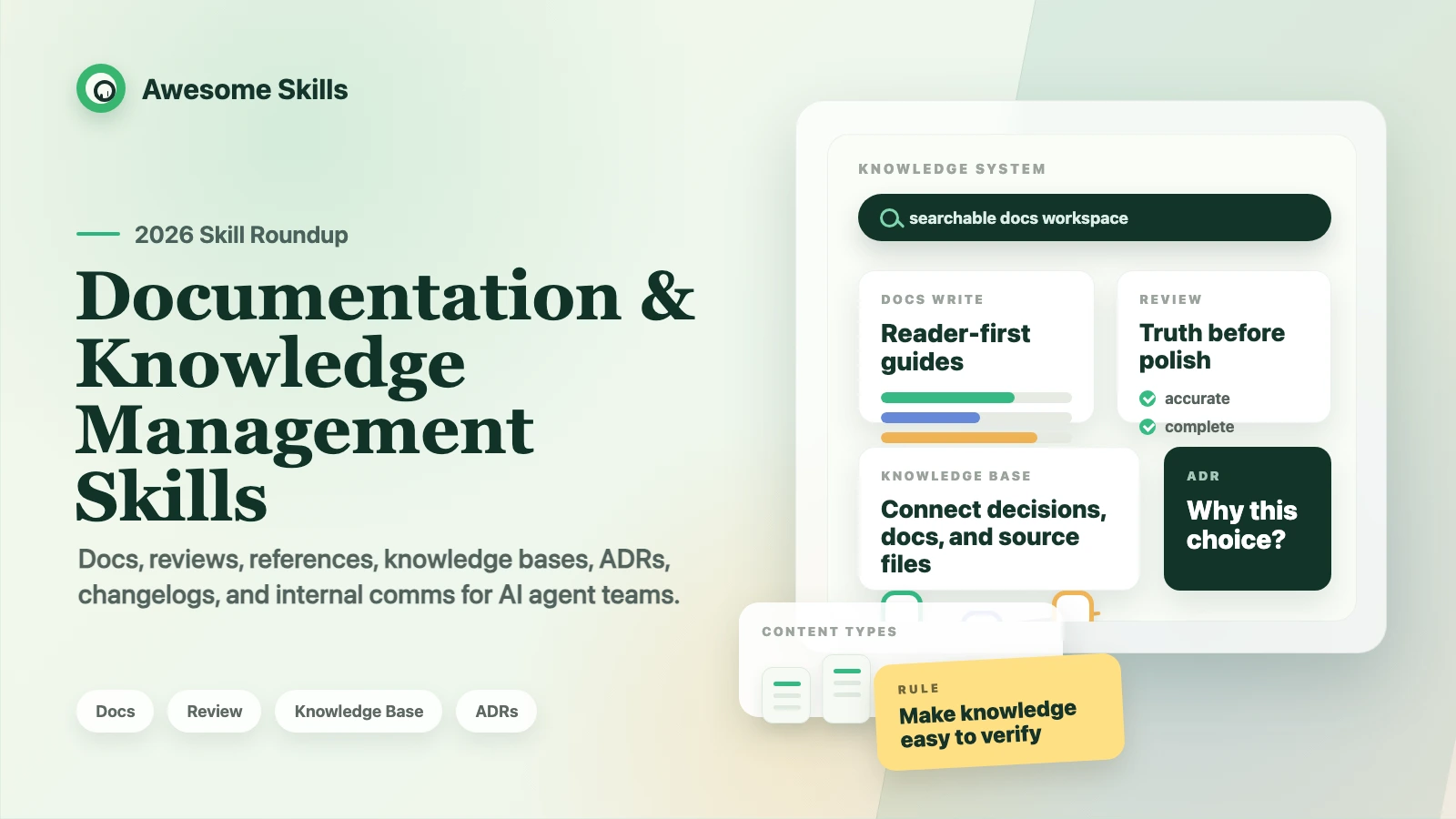
Documentation and Knowledge Management Skills for AI Agents in 2026
Documentation and knowledge management skills are easy to underestimate. They look less dramatic than browser automation, code review, or data pipelines. But they solve one of the oldest problems in software teams: useful knowledge is scattered across code comments, README files, release notes, support threads, design decisions, docs pages, Slack messages, and people's heads.
AI agents make that problem more visible. An agent can write a feature quickly, but if it cannot explain the decision, update the docs, preserve the API contract, or leave a usable trail for the next person, the team still pays for the work later. Good documentation skills help an agent turn work into durable knowledge.
For this guide, we reviewed documentation and knowledge-related entries in the current Awesome Skills index, then checked public guidance from Google's developer documentation style guide, the Microsoft Writing Style Guide, the Diataxis documentation framework, and Anthropic's Agent Skills documentation. This is not a ranking. It is a map of which documentation skill fits which job.
How We Picked the Shortlist
Searching for "documentation" catches a wide mix: doc writers, docs reviewers, docstring helpers, Word and PDF processors, Markdown converters, OpenAPI generators, changelog tools, runbook authors, knowledge-base templates, internal communications, and style guides. For this article, we focused on skills that directly help an agent with one of these workflows:
- writing new docs from product or code context
- reviewing docs for accuracy, structure, and missing steps
- documenting code with docstrings and API references
- converting documents into formats an agent can analyze
- building or maintaining a searchable knowledge base
- recording architectural decisions and release history
- turning team updates into clear internal communication
- applying style and structure rules consistently
The strongest skills do not just produce more prose. They help the agent ask what the reader is trying to do, what source of truth should be trusted, what changed, and how the next person will verify the answer.
The Documentation Skills Worth Trying First
| Skill area | Representative skill | Best fit | Watch out for |
|---|---|---|---|
| Docs writing | docs-write | Creating or updating product docs, developer docs, guides, and feature explanations | Docs should be grounded in real behavior, not inferred from names |
| Docs review | docs-review | Checking docs for accuracy, clarity, missing context, and stale instructions | Review needs source comparison, not taste-based editing |
| Code documentation | docstring | Function, class, module, and API-level code explanations | Docstrings should not repeat obvious implementation details |
| API documentation | openapi-spec-generation | OpenAPI specs, endpoint references, schemas, parameters, and examples | Generated API docs need contract validation |
| Document editing | docx | Word documents, structured reports, redlines, and formatted docs | Formatting preservation matters as much as text quality |
| Document conversion | markitdown | Converting PDF, Word, PowerPoint, Excel, HTML, CSV, and other files into Markdown | Conversion can lose tables, captions, and document hierarchy |
| Knowledge bases | knowledge-base-templates | Internal wiki structure, reusable templates, and knowledge capture | A knowledge base needs ownership and pruning |
| Decision records | architecture-decision-records | ADRs, tradeoff records, and why-we-chose-this explanations | ADRs should record real decisions, not justify them after the fact |
| Changelogs | changelog-automation | Release notes, product changes, developer-facing change history | Changelogs need user impact, not commit-message dumps |
| Internal comms | internal-comms | Team updates, announcements, summaries, and stakeholder messages | Communication should be concise and audience-specific |
If you only start with one category, start with docs review. Bad docs can look polished while still being wrong. A review skill that checks instructions against code, screenshots, API behavior, or source files is often more valuable than another first-draft writer.
1. Docs Writing Skills Need Reader Intent
The best docs writing skill starts by asking who the reader is and what they are trying to accomplish. A new user needs orientation. A developer integrating an API needs exact parameters. A teammate debugging a system needs failure modes and operational context.
That is why docs-write is more useful when the task includes inputs: product behavior, code paths, screenshots, existing docs, release notes, and the intended reader. Without those, an agent may produce clean prose that sounds plausible but does not match the product.
Google's developer documentation style guide emphasizes clear and consistent technical writing for developers and technical practitioners. That maps well to agent work. The agent should prefer active voice, precise nouns, concrete examples, and predictable structure over decorative writing.
For documentation and knowledge management skills, the right prompt is not "write docs for this feature." It is closer to: "identify the reader, inspect the implementation and existing docs, update only the affected sections, include examples, and mark anything you could not verify."
2. Docs Review Skills Protect the Source of Truth
Documentation review is a different job from copy editing. Copy editing improves wording. Docs review asks whether the instructions are true, complete, and maintainable.
docs-review fits this layer. It is useful when a team has docs that may have drifted from the product, a release that changed behavior, or a feature where the documentation must be checked before launch.
A good review skill should compare claims against evidence. Does the UI label still exist? Does the CLI flag work? Does the endpoint return the documented field? Is the migration step still required? Does the troubleshooting guide cover the most likely failure?
The Microsoft Writing Style Guide is helpful here because it keeps the tone practical: simple language, useful guidance, and text that helps the reader move forward. But style is only one part. The deeper question is whether the doc can be trusted.
Ask the agent to separate findings by severity: incorrect, missing, confusing, outdated, or style-only. That prevents a review from becoming a pile of edits with no priority.
3. Docstrings and API References Should Serve Future Maintainers
Code documentation is most useful when it explains intent, contracts, side effects, and edge cases. It is least useful when it restates the implementation line by line.
docstring is a good representative for this category because codebases need consistent function and module documentation, especially when APIs are used by many contributors. The skill should help explain what a function accepts, what it returns, what can fail, and when a caller should not use it.
API documentation is nearby but broader. openapi-spec-generation helps when the output needs to be a contract: endpoints, request bodies, response schemas, authentication, error cases, pagination, and examples.
Microsoft's guidance on reference documentation notes that consistent structure and wording help developers find details quickly. That matters for agent-generated API docs. The agent should not invent a response field because a name sounds likely. It should inspect source routes, schemas, tests, or generated OpenAPI output.
For API docs, examples are high value. A precise request, a realistic response, and one failure case often help more than another paragraph of explanation.
4. Document File Skills Keep Knowledge Portable
Not all knowledge lives in Markdown. Teams still use Word docs, PDFs, slide decks, spreadsheets, exports, proposals, legal drafts, research reports, and customer documents.
docx is useful when the agent needs to create, edit, comment on, or preserve structure in Word documents. That matters for reports, policies, contracts, proposals, and review workflows where formatting and revision history are part of the work.
markitdown solves a different problem: bringing many document formats into Markdown so an agent can inspect and reason over them. It is useful for PDFs, Word files, slides, spreadsheets, HTML, CSV, JSON, XML, and other source files that need to become readable context.
The risk is silent loss. Conversion can flatten tables, drop image captions, scramble headings, or separate footnotes from the text they explain. A good document conversion skill should report what it could and could not preserve.
Use these skills when the task starts with files rather than web pages or code. Ask the agent to keep original files intact and create a clean derived artifact.
5. Knowledge Bases Need Structure, Ownership, and Pruning
A knowledge base is not just a folder full of notes. It needs a structure that helps people find answers, decide what is current, and know where to add new information.
knowledge-base-templates belongs in this category. It is useful when a team wants repeatable page types: onboarding guides, troubleshooting pages, decision logs, project briefs, API notes, glossary entries, or runbooks.
The Diataxis framework is a useful mental model because it separates documentation into four reader needs: tutorials, how-to guides, reference, and explanation. An agent can use that distinction to avoid mixing everything into one long page. A tutorial teaches. A how-to helps complete a task. Reference gives exact details. Explanation builds understanding.
Knowledge management skills should also ask about ownership. Who updates this page? What is the source of truth? When should it expire? Which pages should link to it? Without those answers, an agent can create a tidy wiki that decays quickly.
Good knowledge-base work often includes deletion. If a page is stale, duplicated, or contradicted by a newer doc, the agent should say so instead of adding another layer.
6. ADRs, Changelogs, and Internal Comms Capture Context
Some knowledge is not documentation in the narrow sense, but it still matters. Why did the team choose this architecture? What changed in the release? What does customer support need to know? What should the sales team say differently tomorrow?
architecture-decision-records is useful when a technical decision needs a durable explanation. A good ADR should capture the context, options considered, decision, consequences, and what would make the team revisit it.
changelog-automation helps with change history, but the best version is not a prettier git log. It groups changes by audience and explains impact. Developers may need breaking changes and migration steps. Users may need new capabilities and behavior changes. Support teams may need known issues and workarounds.
internal-comms fills the communication layer. It can turn a release, incident, roadmap update, or project decision into a message for the right audience. The key is audience fit. An engineering summary, executive update, and customer-facing note should not sound the same.
These skills help agents preserve context before it disappears.
7. A Practical Stack for Documentation Work
For most teams, a compact documentation stack works better than installing every related skill:
- docs-review to find stale, incorrect, or missing docs.
- docs-write to update affected pages with reader intent and verified context.
- docstring for code-level explanations that help maintainers.
- openapi-spec-generation when endpoint contracts need reference docs.
- docx and markitdown when the source material lives in files.
- knowledge-base-templates to keep internal wiki pages consistent.
- architecture-decision-records to preserve why a decision was made.
- changelog-automation and internal-comms to explain changes to the right audience.
That order is deliberate. Review the current truth first. Write only where the gap is real. Preserve source documents and contracts. Then turn the result into knowledge that other people can find and maintain.
Why Trust This Guide
This guide is based on current Awesome Skills entries that support docs writing, docs review, docstrings, API references, document editing, document conversion, knowledge-base templates, ADRs, changelogs, and internal communication. We also checked established documentation guidance from Google, Microsoft, Diataxis, and Anthropic so the article does not treat documentation as generic content generation.
The lens is practical fit. A good documentation skill should make an agent more accurate, more structured, and more accountable. It should help the next reader understand what changed, why it changed, and how to verify it.
Final Takeaway
Documentation and knowledge management skills are where AI agents become better teammates. They turn work into memory: clear docs, verified references, preserved files, searchable knowledge bases, decision records, changelogs, and useful internal updates.
If you want to explore more, start with the Awesome Skills collection, search for "docs-write", "docs-review", "docstring", "OpenAPI", "docx", "markitdown", "knowledge base", "ADR", "changelog", or "internal comms", and read the actual SKILL.md instructions before installing. The skill name tells you the output. The workflow tells you whether it can keep knowledge trustworthy.